 How-to
How to Choose Exterior Paint Colors for Your Home
Last Updated: November 15, 2026
Quick Summary
To choose exterior paint colors, start with the fixed finishes you cannot paint: brick, stone, roofing, and siding. Pull one undertone from those finishes and build the rest of the palette around it, then confirm finalists with 8x10 inch samples taped to at least two sides of the house.
- A balanced exterior paint scheme typically uses up to three distinct colors plus the roof color.
- Experts recommend 8x10 inch samples instead of small paper chips.
- Bold body colors can shrink the potential buyer pool by up to 30%.
- The trim layer accounts for roughly 30% of a palette's success or failure.
- Warm neutrals and earthy tones are leading choices for 2026, with white and off-white remaining the top homeowner choice.
Table of Contents
- Start With the Fixed Finishes You Cannot Paint
- How to Choose Exterior Paint Colors With Samples
- Use an Exterior House Color Visualizer Before You Commit
- Outside House Painting Color Combinations That Hold Up
- Paint Colors for House Exterior With Photos: What to Look For
- Common Mistakes That Wreck a Color Scheme
- Request a Quote and Get Your Color Plan Painted Right
- Frequently Asked Questions
Start With the Fixed Finishes You Cannot Paint
Most homeowners start with the paint. That is the wrong end of the process. The right way to choose exterior paint colors is to start with the parts of your house that will not change: brick, stone, roofing, and siding. These fixed finishes set the boundaries for everything else.
Homeowners who pick a favorite color first often end up repainting within a few years. Homeowners who build the palette around the brick and roof tend to get it right the first time.
Brick, Stone, and Roof Color Set the Boundaries
Your brick and stone have undertones you cannot paint over. A red brick with warm undertones will fight a cool gray trim. A gray stone with cool undertones will look dirty next to a cream body color.
Roof color matters just as much. A dark charcoal roof calls for lighter body colors to keep the house from looking top-heavy. A brown roof pairs best with warm neutrals.
Here is the rule we use: pull one undertone from your fixed finishes and build the rest of the palette around it.
- Warm brick or stone: lean toward warm whites, greiges, and earthy tones
- Cool stone or gray siding: lean toward cool grays, soft blues, and crisp whites
- Dark roof: choose a lighter body color for balance
- Light roof: you have more room for a darker body color
Match the Palette to Your Home's Architectural Style
Style should drive the color, not the other way around. A Craftsman bungalow looks wrong in bright modern gray. A mid-century ranch looks wrong in heavy Victorian colors.
A standard, balanced exterior paint scheme typically uses up to three distinct colors plus the roof color, according to RTA Studio's guide to exterior color coordination. That structure keeps a home looking deliberate instead of busy.
Quick style guide:
- Craftsman: earthy greens, warm browns, cream trim
- Colonial: white or soft yellow body, dark shutters, white trim
- Modern: charcoal, warm white, black accents
- Ranch: muted sage, warm gray, off-white trim
- Victorian: deeper body colors with contrasting trim in two tones
How to Choose Exterior Paint Colors With Samples
You cannot choose exterior paint colors from a paper chip. Small chips do not show how a color will look across a large wall in real sunlight, and experts recommend using 8x10 inch samples instead, according to Heartwork Org's paint sampling guidance.
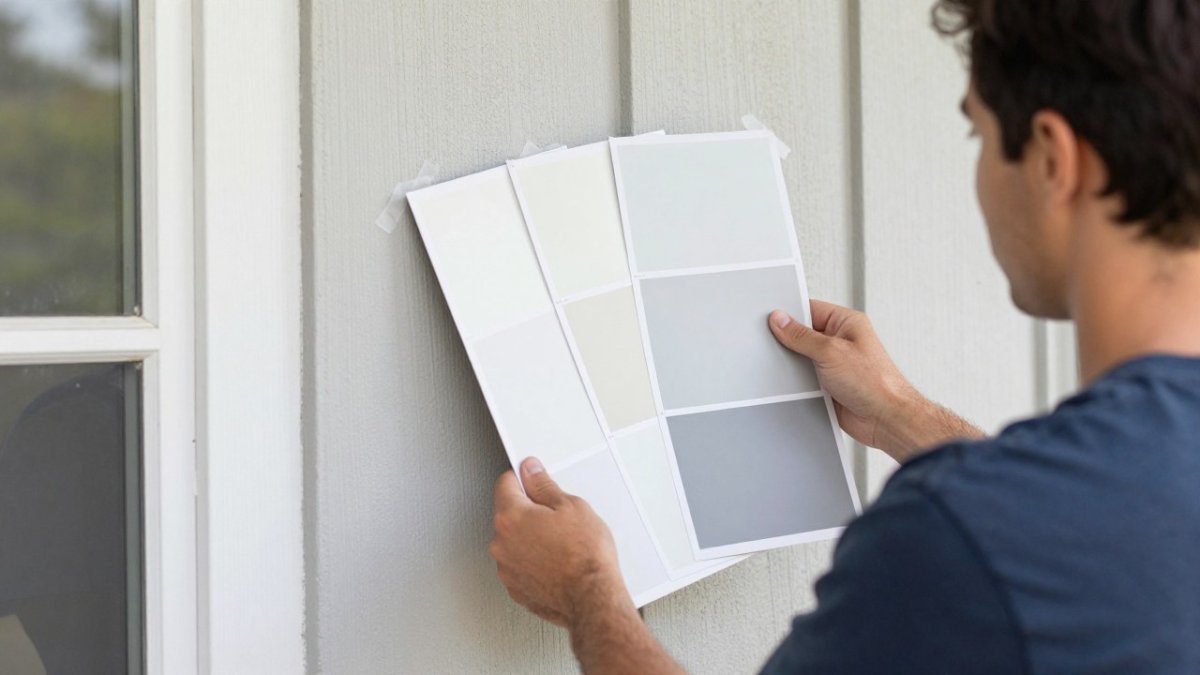
Here is a practical sample process:
- Pick three to five candidate colors, no more.
- Order 8x10 inch samples or paint them onto foam boards.
- Tape the boards to at least two sides of the house.
- Check them in morning light, midday sun, and evening shade.
- Look at each board next to your brick, roof, and trim.
- Narrow to two colors, then live with them for a week.
Why the Same Color Looks Different on Every Wall
The thing nobody tells you about exterior paint colors is that they shift through the day and around the house.
Orientation and sun exposure. A wall facing south receives direct, intense sun for most of the day, which washes out color and makes it read lighter and warmer.
Reflected light from surroundings. Trees, lawns, driveways, and neighboring homes bounce color onto your walls.
Sheen changes perceived color. The same tint in a flat finish and a satin finish does not look the same.
Weather and season. Overcast days mute color and pull out cool undertones; bright clear days push warmth. A sample tested only during a rainy week can mislead you.
Watch out: testing all your samples on one side of the house in one afternoon is the most common way homeowners get surprised after the paint goes up.
A Sample Log That Makes the Decision Objective
Instead of relying on memory, keep a simple log for each candidate. Note the color name and number, the sheen, which wall it was taped to, the time of day, and a one-line reaction. After a week you will have a record that shows which color held up across every condition rather than which one looked best in a single flattering photo. Often, the strongest finalists are the colors that never looked wrong, not the ones that looked spectacular once.
Use an Exterior House Color Visualizer Before You Commit
An exterior house color visualizer is a tool that lets you upload a photo of your home and test paint colors on it before buying a single gallon. Many paint brands offer one online.
The visualizer is a fast filter, not a final answer. Screens and outdoor light do not match. Use it to rule out colors that clearly clash, then confirm your finalists with real samples on the wall.
What the visualizer is good for:
- Seeing how a body color and trim color interact
- Testing a bold door color without painting anything
- Comparing two palettes side by side
- Sharing options with family before deciding
What it cannot do:
- Show true color in your specific light
- Account for the exact texture of your siding or brick
- Replace a physical sample
Outside House Painting Color Combinations That Hold Up
Outside house painting color combinations that last share one trait: restraint.
White and off-white exterior colors remain the top choice for homeowners, according to Carolina Renew's analysis of exterior color trends. That is not boring. It is durable. Neutrals stay in style and help a home sell.
The trim layer accounts for roughly 30% of a palette's success or failure, according to Facade Colorizer's exterior color guide. That is a big share for a small surface. Get the trim wrong and the whole scheme looks off.
Combinations that hold up:
- Warm white body, soft gray trim, black door
- Greige body, white trim, dark charcoal shutters
- Sage green body, cream trim, warm brown door
- Mid-gray body, white trim, navy door
- Earthy terracotta accent door on a neutral body
Notice the pattern. Neutral body, lighter trim, one accent. Bold accent colors on doors can boost return on investment, while bold body colors may hurt buyer interest, according to Facade Colorizer's 2026 pillar guide.
Paint Colors for House Exterior With Photos: What to Look For
Paint colors for house exterior with photos are useful, but only if you read them correctly. Most people look at the color and ignore everything else in the frame.
When you study a photo, check these:
- Light direction: is the sun hitting the wall directly or at an angle?
- Time of day: morning, midday, and evening give three different colors
- Surroundings: trees, lawn, and neighboring homes reflect light onto the wall
- Trim contrast: how strong is the difference between body and trim?
- Roof tone: does the roof match the warmth or coolness of the body?
Architectural Digest notes that homeowners are prioritizing classic, versatile palettes over short-lived trends, according to Architectural Digest's exterior color gallery. That is the right instinct. A photo of a color you love on someone else's house may not work on yours.
Save photos that match your home's style, roof color, and light exposure. Ignore the rest.
Common Mistakes That Wreck a Color Scheme
The biggest mistake is choosing from a small chip. The second biggest is choosing a bold body color. Bold body colors can shrink the potential buyer pool by up to 30%, according to Facade Colorizer's color and resale analysis.
Watch out: painting the trim the same color as the body flattens the whole house. It removes the visual contrast that defines windows, rooflines, and doors.
Other mistakes we see:
- Skipping the roof color when building the palette
- Ignoring HOA or historic-district rules until after the paint is bought
- Testing samples on one side of the house only
- Choosing a color from a photo without a real sample
- Using too many colors at once
Most exterior color schemes fail for a handful of avoidable reasons, and each one has a straightforward fix.
| Mistake | Why it hurts | Fix |
|---|---|---|
| Choosing from a small chip | Chips do not show color on a large wall in sunlight | Use 8x10 inch samples on foam boards |
| Choosing a bold body color | Can shrink the potential buyer pool by up to 30% | Keep the body neutral, put bold color on the door |
| Painting trim the same color as the body | Flattens the house and removes visual contrast | Use a contrasting trim color |
| Skipping the roof color | Palette can look top-heavy or mismatched | Build the palette around roof tone |
| Ignoring HOA or historic-district rules | Rules discovered after paint is bought | Check rules before buying paint |
| Testing samples on one side only | Color shifts on other walls go unseen | Tape samples to at least two sides |
| Choosing a color from a photo | Another home's light and surroundings differ | Confirm with a real sample |
| Using too many colors at once | Scheme looks busy instead of deliberate | Limit to up to three colors plus roof |
Request a Quote and Get Your Color Plan Painted Right
Getting the color right is half the job. Getting it applied right is the other half. A perfect palette on a poorly prepped wall will fail within a season.
If you are weighing bids, read how to assess home renovation quotes before you sign so you know what a fair quote should include.
Wizard Restoration and Remodeling LLC provides exterior painting, siding, roofing, and gutter services as one team. That matters when your color plan depends on the roof and trim being in good shape.
Get started with Wizard Restoration and Remodeling LLC and turn your color plan into a finished exterior.
Your exterior takes a beating every year, and a fading or peeling paint job is often the first sign of deeper wear. Wizard Restoration and Remodeling LLC brings painting, siding, roofing, and gutter work under one team, so your color plan and your home's protection get handled together.
Frequently Asked Questions
What colors should I consider when choosing paint colors for my exterior house?
Start with white, off-white, or warm neutrals, which are popular choices for many homeowners. A balanced scheme typically uses up to three colors plus the roof color, and the trim layer accounts for roughly 30% of the palette's success. Pull one color from your brick, stone, or roof so the house looks intentional rather than painted in unrelated blocks.
Is there an app to choose exterior house colors?
Yes. An exterior house color visualizer lets you upload a photo of your home and swap body, trim, and accent colors digitally. Use it to narrow the field, not to make the final call. Screens distort color, so confirm your top two or three choices with physical samples on the actual wall before you buy paint. The visualizer saves you from expensive mistakes, but it cannot replace a real sample in real light.
How many colors should I use on a house exterior?
A standard exterior paint scheme uses up to three distinct colors in addition to the roof color: a main body color, a trim color, and an accent for the door or shutters. More than that starts to look busy. Keep the body color neutral and let the accent do the talking. Bold accent colors on doors are often a low-risk choice, while bold body colors can limit buyer interest.
How can I test exterior paint colors before painting my house?
Skip the small paint chip. Larger samples work better than a tiny chip because a chip does not show how a color reads on a large surface in natural light. Paint the sample on a section of siding that faces different directions, then check it in morning, midday, and evening light. Live with it for a few days before you commit to the full exterior paint colors.